Legacify

Family Tree

Recording Nigerian family lineage as families actually hold it.

The first module of Legacify, an archive for Nigerian heritage.
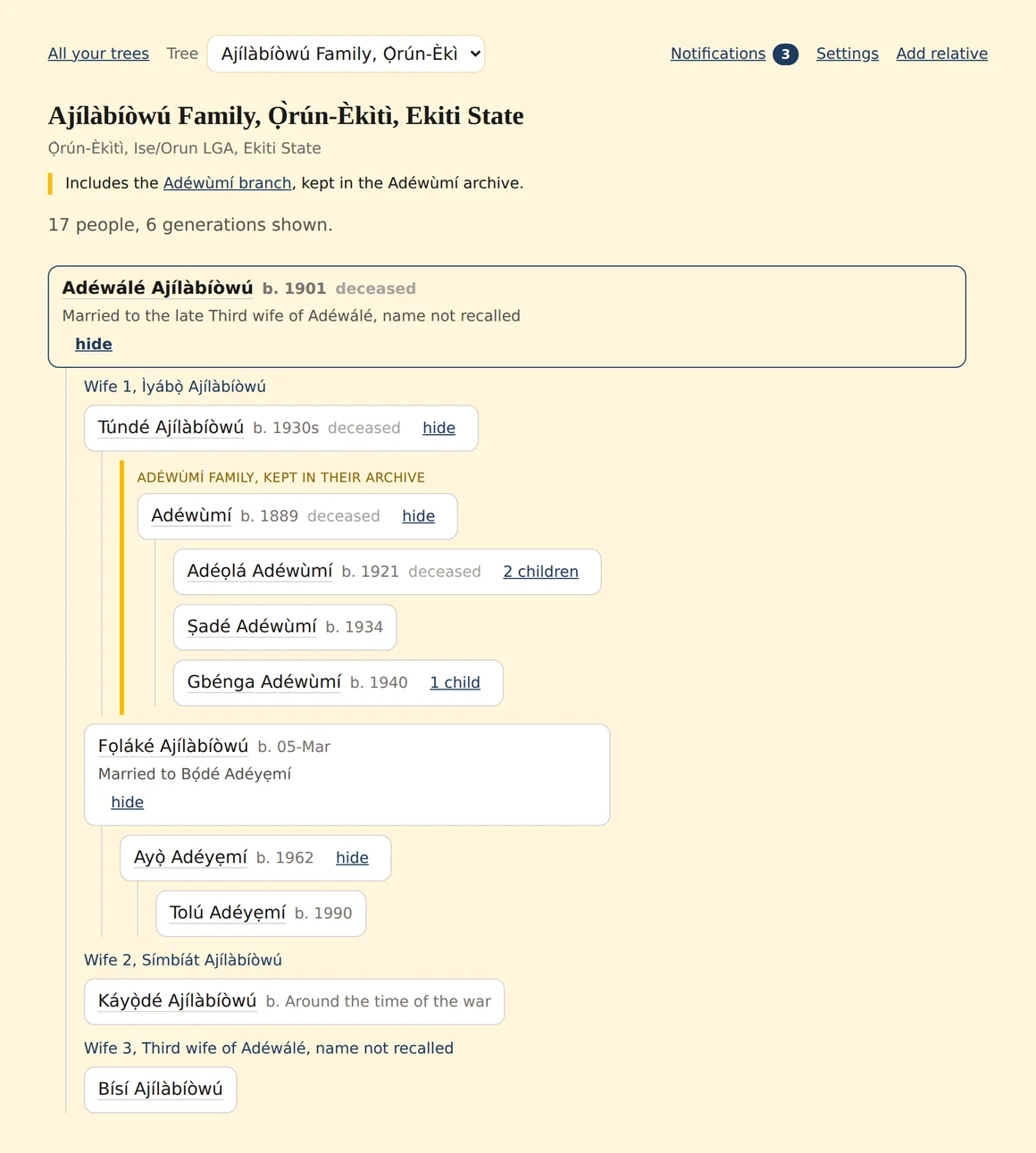
A family tree on Legacify. One man at the head, three wives listed as Wife 1, Wife 2 and Wife 3, the third recorded as name not recalled. Children under each wife, one born in the 1930s, one born around the time of the war, and a daughter with her own child and grandchild beneath her. Under the first son, the Adéwùmí branch is drawn in place, marked as kept in its own archive.
Ajílàbíòwú, one of the ten pilot families, with the Adéwùmí branch drawn inside it. The people shown are sample records.

Already part of a family archive here? Sign in to open it.

Sign in

Signing in does not add you to a family. Someone already in that family has to.


Not sure whether your family is already recorded? Sign in and search for it. If nobody has recorded it yet, you can open its archive yourself from there.


What Legacify is for

Legacify is a digital archive for Nigerian heritage. Most of that heritage lives with elders or in cupboards, and both are running out of time. The Family Tree is the first part of it.

How the Family Tree works

A family's Head Admin opens an archive and records the people in it. Relatives then claim their own records and keep them correct.

More than one wife, a daughter's own branch, fostering, several names and a birth date known only to the decade are all ordinary here.

Watch it, step by step

Short videos in English, Yorùbá and Hausa. The families in them are made up. See all the videos

  • 01

    What is Legacify Family Tree? As simple as A, B, C

  • 02

    Signing in, and signing out

  • 03

    Finding your family

  • 04

    Asking to join your family's archive

  • 05

    Opening your family's archive

Videos play from YouTube (Google, United States), only once you press play.

Watch the English series on YouTube

What it looks like

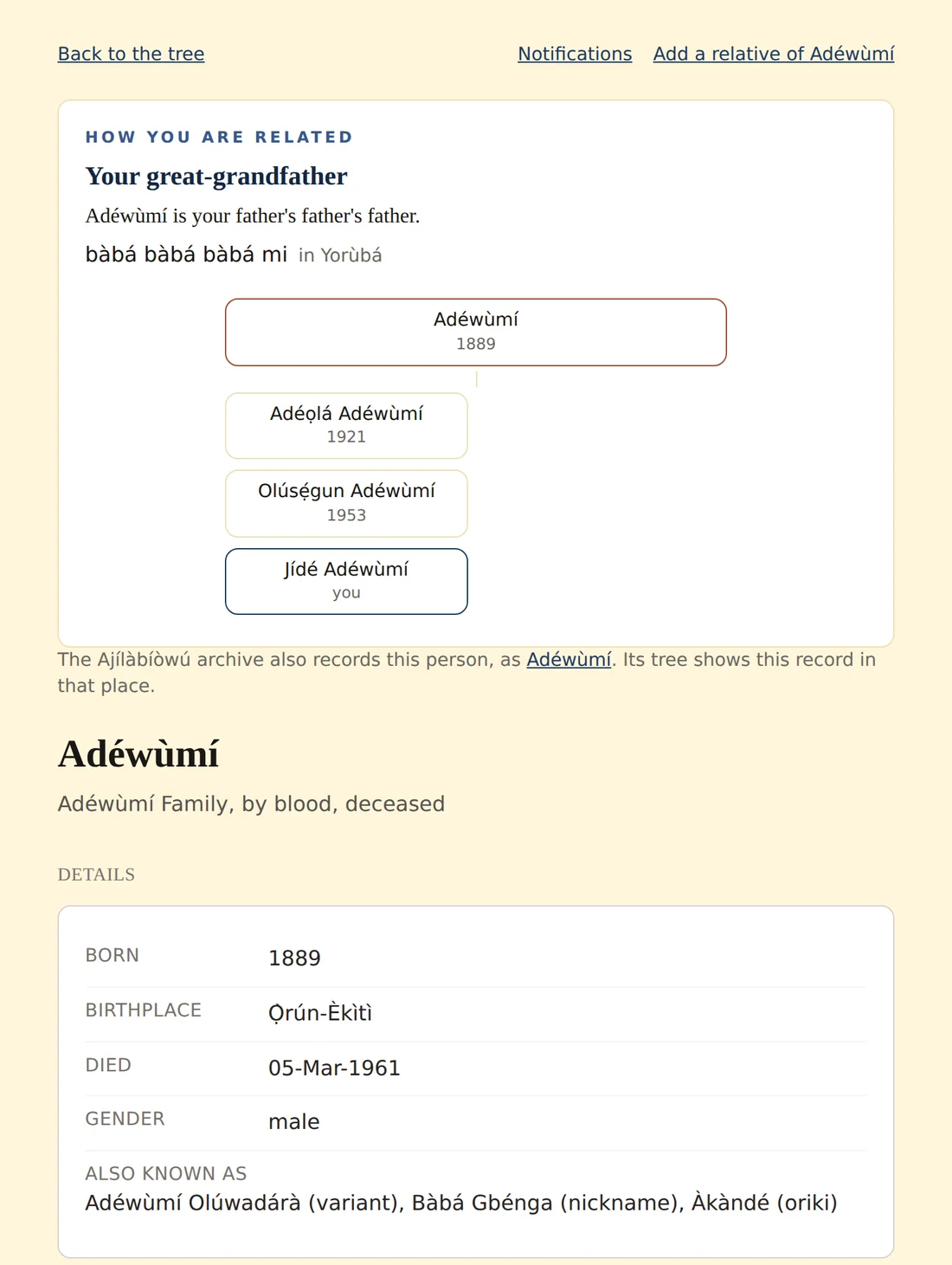
A person's record on Legacify. A panel at the top headed how you are related reads your great-grandfather, Adéwùmí is your father's father's father, and bàbá bàbá bàbá mi in Yorùbá, with the line drawn down through three generations to the reader. Below it the record shows year of birth, gender, and three other names he answered to.
Adéwùmí. How you are related, in English and in the family's own language.
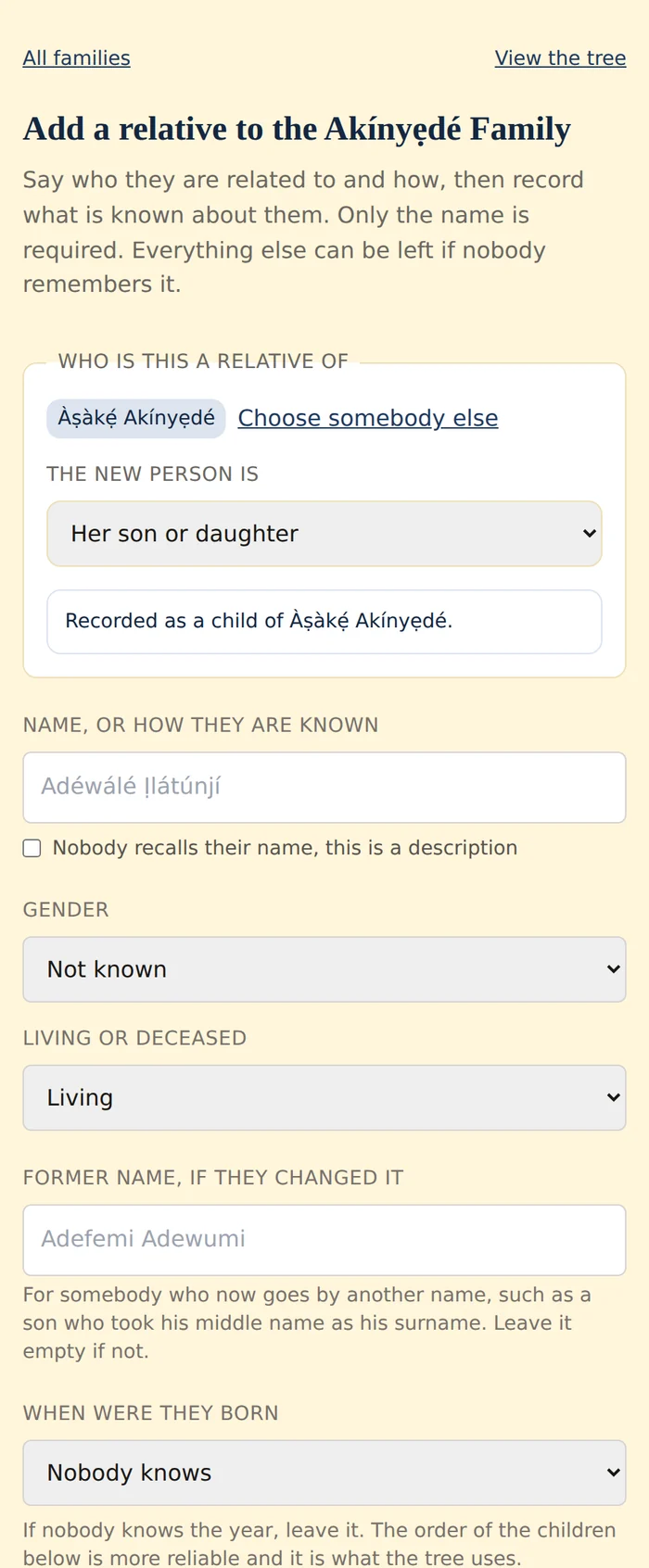
Adding a relative on a phone. First a question asking who the new person is related to and how, then the details form with fields for the name, a checkbox reading nobody recalls their name this is a description, gender, living or deceased, and when they were born with the option nobody knows.
Akínyẹdé. Recording a relative. Only the name is required.
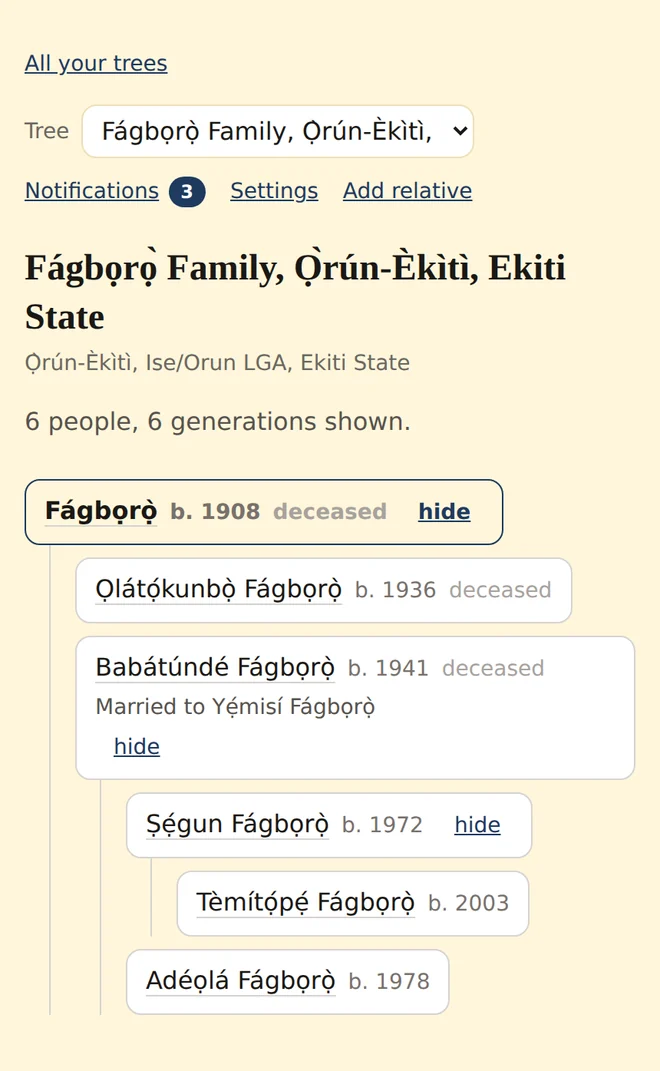
A family tree on a phone screen, four generations stacked in a single readable column from the oldest man recorded down to a grandchild born in 2003.
Fágbọrọ̀. Four generations on a phone.

What a family keeps hold of

Where the work has reached

The Family Tree has been live since 1 October 2026, for any Nigerian family. The Archive is built as a pilot and not yet open. The Studio is designed.

Where it began: the ten families of Ọ̀rún-Èkìtì

No two of these trees are the same shape. The people shown are sample records.
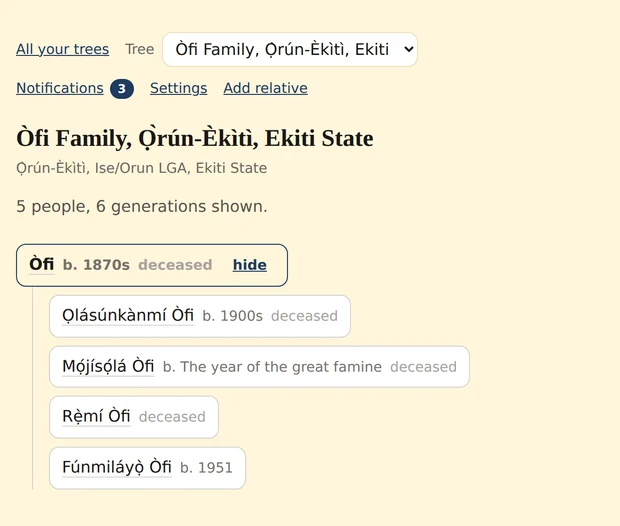
The Òfi family tree, showing births recorded as a decade, as the year of the great famine, and one with no date at all.
Òfi. Birth years as the family remembers them.
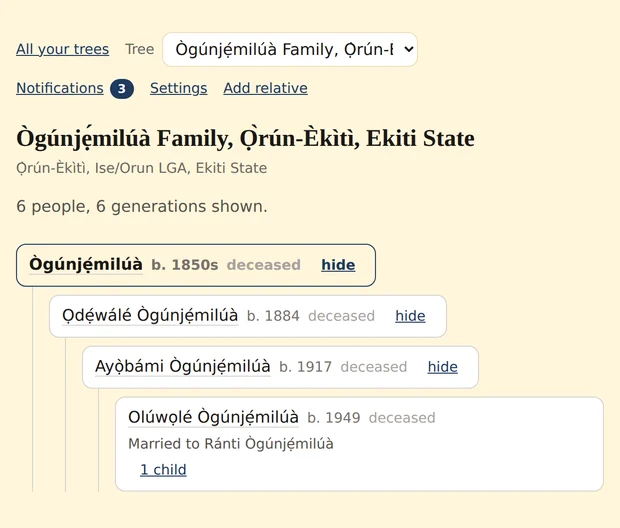
The Ògúnjẹ́milúà family tree, showing five generations of one line from the 1850s to the present.
Ògúnjẹ́milúà. Five generations in one line.
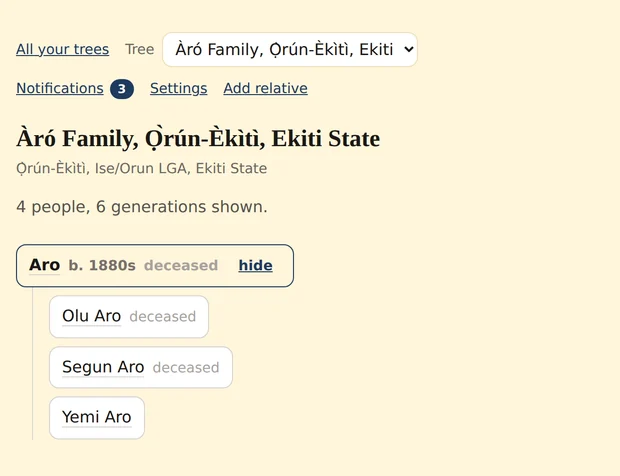
The Àró family tree, showing four children of one household in birth order.
Àró. Four children in birth order.
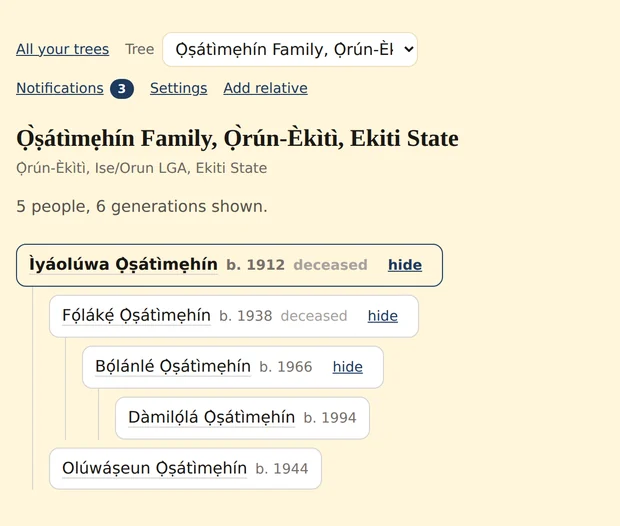
The Ọ̀ṣátìmẹhín family tree, with a woman at the head of it and the line running down through her daughter and granddaughter.
Ọ̀ṣátìmẹhín. A line that runs through daughters.
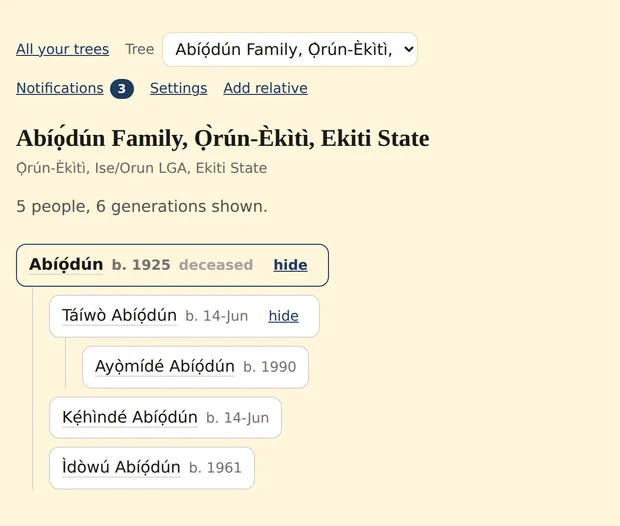
The Abíọ́dún family tree, showing Táíwò and Kẹ́hìndé both born on the fourteenth of June 1958, and Ìdòwú born three years after them.
Abíọ́dún. Táíwò, Kẹ́hìndé and Ìdòwú.
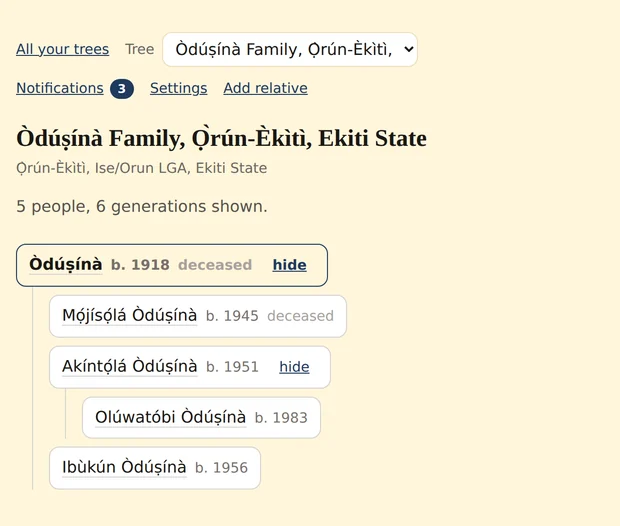
The Òdúṣínà family tree, showing a daughter raised in the house from infancy listed among the children born to it.
Òdúṣínà. A daughter raised in the house, recorded as adoptive.

And every part of the country

Legacify is for every Nigerian family. These sample families are made up, because a real family's archive is private.
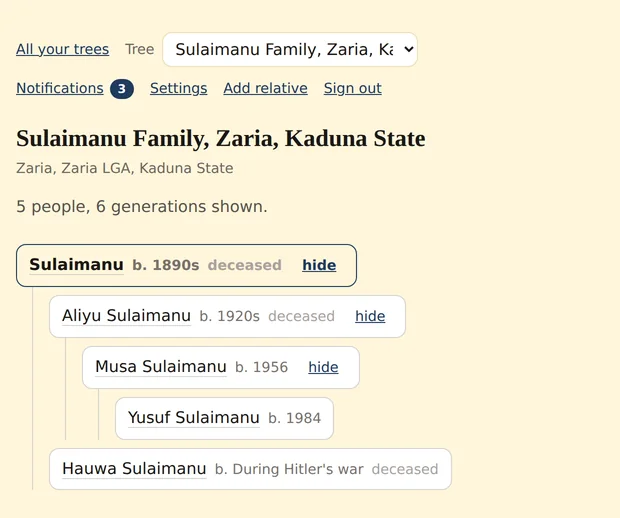
A sample family tree for the Sulaimanu family of Zaria, Kaduna State. The founder is recorded as born in the 1890s, a son in the 1920s, and a daughter as born during Hitler’s war.
North West. Sulaimanu of Zaria, Kaduna State.
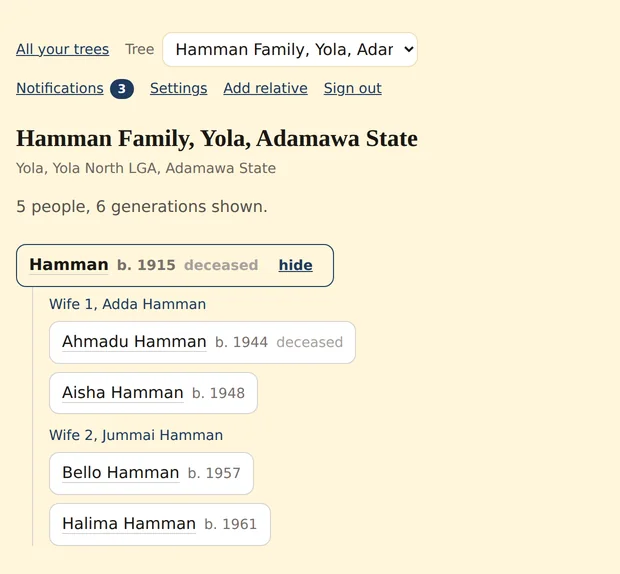
A sample family tree for the Hamman family of Yola, Adamawa State. Two wives are listed, with two children under each.
North East. Hamman of Yola, Adamawa State.
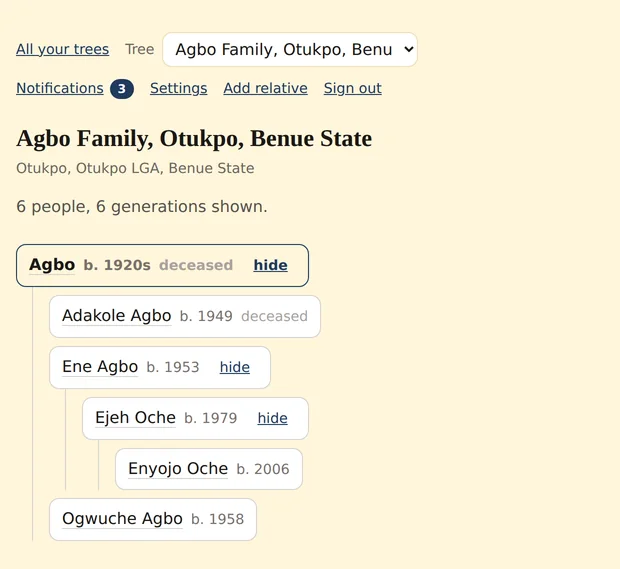
A sample family tree for the Agbo family of Otukpo, Benue State. A daughter, Ene, has her son and granddaughter listed beneath her under the surname Oche.
North Central. Agbo of Otukpo, Benue State.
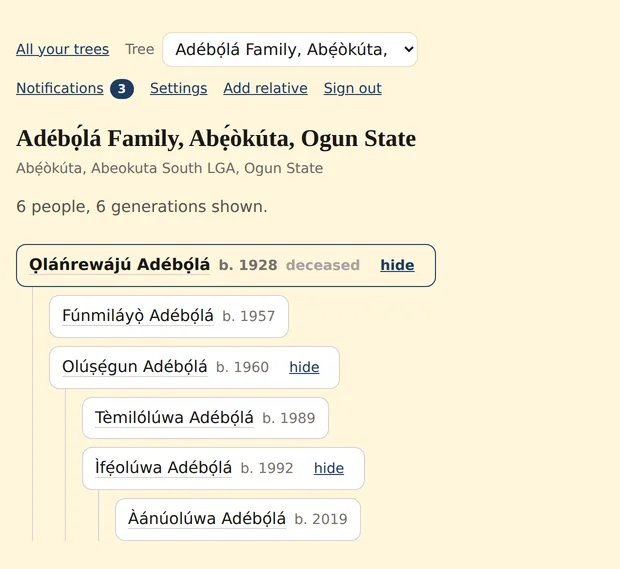
A sample family tree for the Adébọ́lá family of Abẹ́òkúta, Ogun State, running four generations from a man born in 1928 to a child born in 2019.
South West. Adébọ́lá of Abẹ́òkúta, Ogun State.
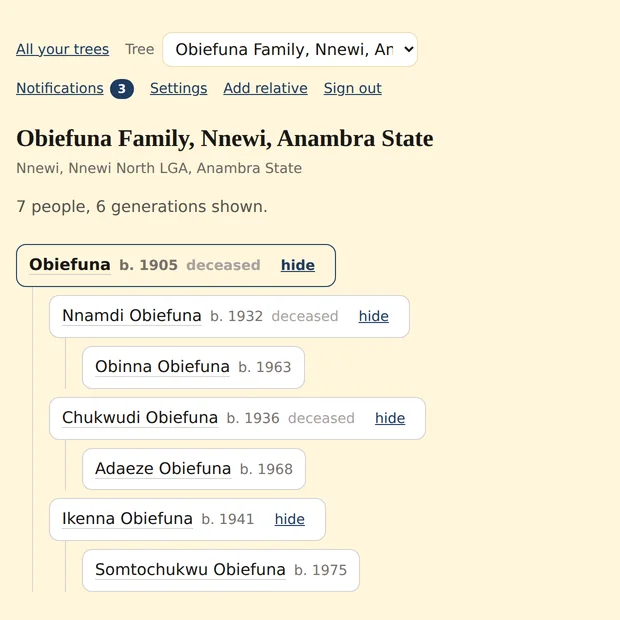
A sample family tree for the Obiefuna family of Nnewi, Anambra State. Three sons are listed in birth order, each with a child beneath him.
South East. Obiefuna of Nnewi, Anambra State.
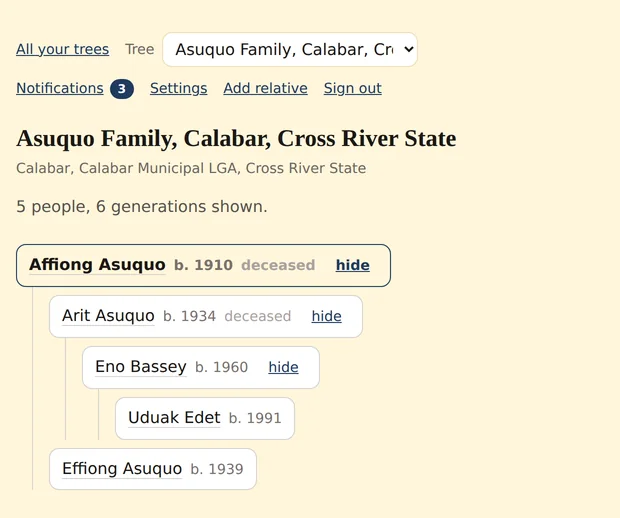
A sample family tree for the Asuquo family of Calabar, Cross River State, with a woman at the head of it and the line running down through her daughter and granddaughter.
South South. Asuquo of Calabar, Cross River State.

Help us build the rest

Legacify is a project of Legacy Lab NG. We are looking for sponsors and grants, families to record next, partners and institutions, and volunteers.

Write to hello@legacylab.ng or use the contact form.

Part of a family already recording here?

Sign in to your family archive